EVENTI

EVENTI

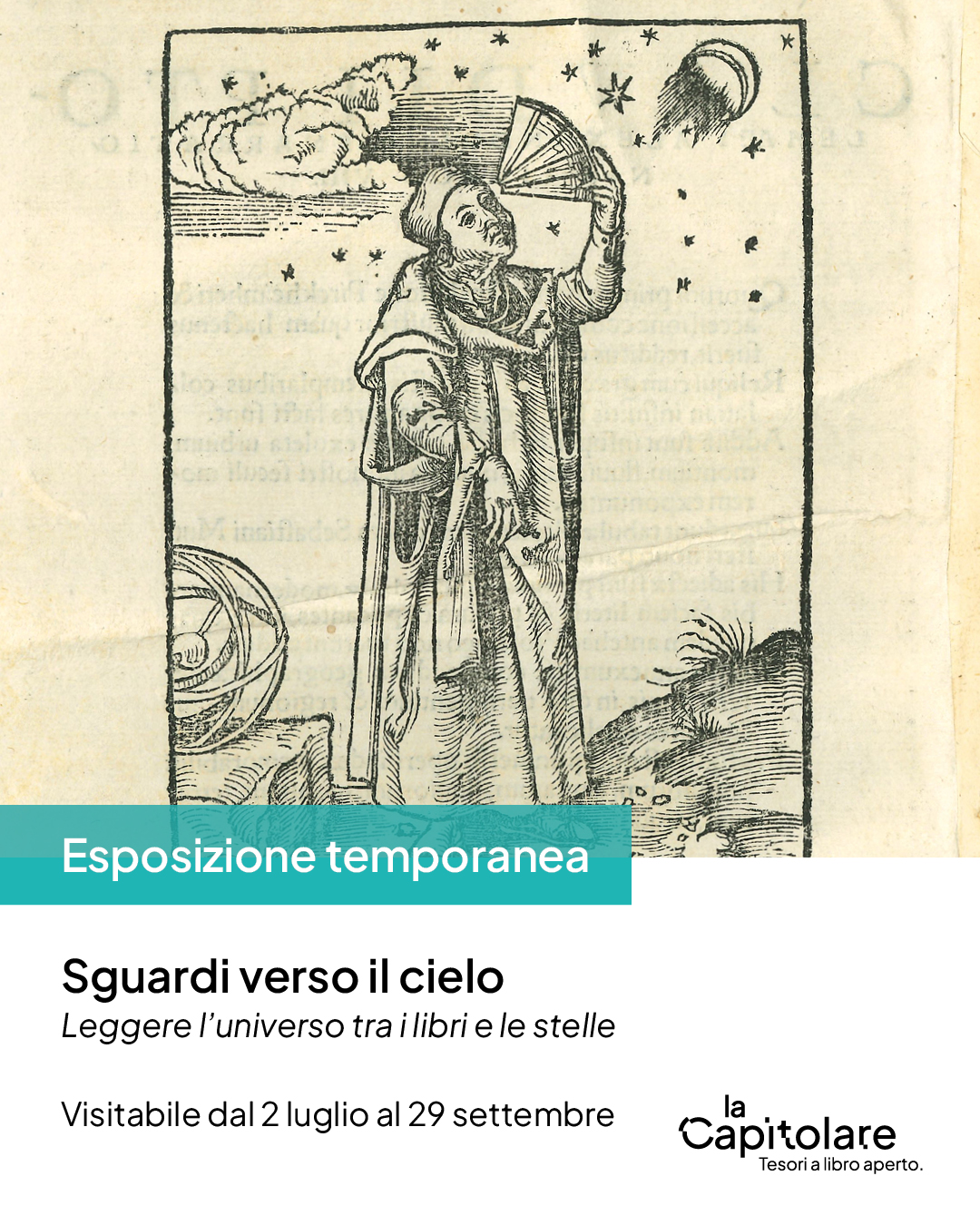
The exhibition stems from a dialogue between the manuscripts and ancient books preserved in the Capitolare, in which astronomy emerges as a field of knowledge in constant transformation, suspended between observation, calculation, religion and philosophical reflection. Indeed, the sky has always been linked to humanity’s fundamental questions: finding one’s bearings in space, measuring time, and understanding the order of the world.

The exhibition begins with the ancient and medieval cosmos: an ordered, finite and hierarchical universe, in which the Earth occupies the centre and the celestial bodies move along concentric spheres. The geocentric model, developed by Greek natural philosophy and systematised by Ptolemy, spanned the Middle Ages and continued to be passed down, studied and depicted in works such as Giovanni Sacrobosco’s Sphaera mundi, through diagrams, maps, constellations, tables and calculating instruments.

With Copernicus, the perspective changed radically: the Earth was no longer the centre of the universe, but a planet orbiting the Sun. The Copernican revolution thus ushered in a new era, characterised by bold hypotheses, resistance, new observations and alternative interpretations.

From Tycho Brahe to Kepler, and on to Galileo and the telescope, the way of studying the heavens was transformed, with increasingly precise observations, new instruments, mathematical calculations and critical analysis. Sunspots, ‘new’ stars, elliptical orbits and astronomical tables paint a picture of a complex and dynamic universe.

The exhibition, included in the admission ticket, will be open until 29 September in the museum spaces of the Biblioteca Capitolare during normal opening hours: Friday to Tuesday from 10.00 to 18.00. The exhibition will also be featured during guided tours.

For information and bookings, please contact info@bibliotecacapitolare.it, or call 3315946961.

Looking up at the sky. Reading the universe through manuscripts and the stars

Temporary exhibition from 2 July to 29 September 2026

The exhibition stems from a dialogue between the manuscripts and ancient books preserved in the Capitolare, in which astronomy emerges as a field of knowledge in constant transformation, suspended between observation, calculation, religion and philosophical reflection. Indeed, the sky has always been linked to humanity’s fundamental questions: finding one’s bearings in space, measuring time, and understanding the order of the world.

The exhibition begins with the ancient and medieval cosmos: an ordered, finite and hierarchical universe, in which the Earth occupies the centre and the celestial bodies move along concentric spheres. The geocentric model, developed by Greek natural philosophy and systematised by Ptolemy, spanned the Middle Ages and continued to be passed down, studied and depicted in works such as Giovanni Sacrobosco’s Sphaera mundi, through diagrams, maps, constellations, tables and calculating instruments.

With Copernicus, the perspective changed radically: the Earth was no longer the centre of the universe, but a planet orbiting the Sun. The Copernican revolution thus ushered in a new era, characterised by bold hypotheses, resistance, new observations and alternative interpretations.

From Tycho Brahe to Kepler, and on to Galileo and the telescope, the way of studying the heavens was transformed, with increasingly precise observations, new instruments, mathematical calculations and critical analysis. Sunspots, ‘new’ stars, elliptical orbits and astronomical tables paint a picture of a complex and dynamic universe.

The exhibition, included in the admission ticket, will be open until 29 September in the museum spaces of the Biblioteca Capitolare during normal opening hours: Friday to Tuesday from 10.00 to 18.00. The exhibition will also be featured during guided tours.

For information and bookings, please contact info@bibliotecacapitolare.it, or call 3315946961.